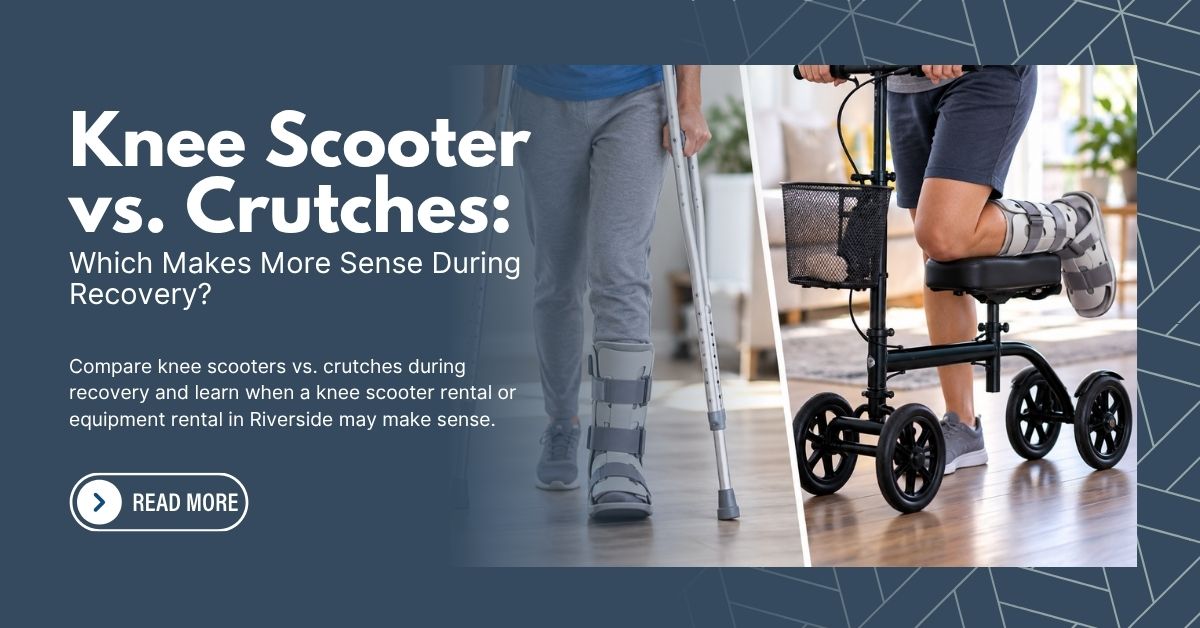
Recovering from a foot, ankle, or lower-leg injury can change the way you handle even the simplest parts of your day.
Getting from the bedroom to the kitchen can suddenly take more effort. Carrying a glass of water becomes complicated. A trip to a medical appointment requires planning. Even moving around the house safely can become something you have to think about.
When a healthcare professional instructs someone to limit or avoid putting weight on an injured leg, two mobility options commonly considered are crutches and knee scooters.
Crutches are familiar, relatively simple, and useful in many situations. Knee scooters can provide another option for certain people who want a different way to move around during recovery.
So which makes more sense?
There isn’t one answer for everyone. The better choice depends on the injury, healthcare instructions, strength, balance, home environment, lifestyle, and how long mobility assistance may be needed.
Understanding the differences can make it easier to discuss your options with your healthcare provider and choose equipment appropriate for your recovery.
How Do Crutches Work?
Crutches help a person move while reducing or avoiding weight on an affected leg, depending on their medical instructions.
They have been used for generations and remain a common choice after many lower-extremity injuries and procedures.
One major advantage is their versatility.
Crutches can be used in relatively small spaces and may be more practical than wheeled equipment in environments involving steps or certain uneven surfaces. They’re also relatively easy to transport in a vehicle.
However, using crutches requires coordination, balance, and upper-body effort. Some people adapt quickly, while others find them tiring or difficult to use for extended periods.
That difference becomes important when deciding what will realistically work during everyday recovery.
What Is a Knee Scooter?
A knee scooter, sometimes called a knee walker, is a wheeled mobility device designed for certain people recovering from an injury or procedure involving one lower extremity.
Instead of supporting the body primarily through crutches, the user generally places the knee of the affected leg on a padded platform while propelling the scooter with the other leg.
For appropriate users, this provides another way to get around without relying on crutches for every trip through the house.
Because many people only need this type of equipment temporarily, a knee scooter rental can make sense during recovery rather than purchasing equipment that may only be needed for several weeks.
A knee scooter isn’t appropriate for every injury or every person, however. The decision should be based on medical guidance as well as the person’s ability to safely operate the device.
Knee Scooter vs. Crutches: What’s the Difference?
Both are designed to assist with mobility, but they work very differently.
Crutches Require More Upper-Body Involvement
Using crutches generally requires significant participation from the arms, shoulders, and upper body.
For some people, that’s manageable.
For others, particularly during a longer recovery, repeatedly moving with crutches can become tiring.
A knee scooter changes how the body is supported and may reduce some of the upper-body demands associated with traditional crutch use.
That doesn’t automatically make the scooter safer or better. It simply makes it a different mobility option.
Knee Scooters Have Wheels
This is an obvious difference, but an important one.
A knee scooter rolls across the ground, which can make moving across suitable flat surfaces convenient. However, wheels also mean the user needs to understand how to steer, brake, stop, turn, and position the device safely.
Crutches don’t roll, but they require the user to coordinate each movement and maintain appropriate balance.
Crutches May Be Better for Certain Spaces
A knee scooter requires enough room to maneuver.
Small bathrooms, narrow hallways, crowded rooms, steps, thick rugs, and uneven surfaces can present challenges.
Crutches may be easier to use in some tighter environments, although stairs and other obstacles still require appropriate instruction and caution.
Before choosing either option, think about the places where the equipment will actually be used.
Think About Your Home Before Choosing
People sometimes choose mobility equipment based entirely on what appears most comfortable.
The home environment matters just as much.
Before bringing a knee scooter home, look at your everyday routes.
Can the scooter move easily between the bedroom, bathroom, kitchen, and living areas?
Look for:
- Loose rugs
- Electrical cords
- Narrow doorways
- Tight corners
- Changes in floor height
- Cluttered walking paths
- Steps between rooms
- Uneven outdoor surfaces
If these obstacles are present, some changes may be necessary.
This is also important from a fall-prevention perspective. Mobility equipment should support safer movement rather than introduce additional obstacles into the home.
Consider How Much You Move During the Day
Think realistically about an ordinary day.
Someone who only needs to move short distances may have very different needs from someone who must navigate a larger home, attend frequent appointments, or continue working during recovery.
Crutches may be practical for short periods and certain environments.
For an appropriate person who has longer distances to cover on suitable surfaces, a knee scooter may offer another way to remain mobile.
A knee scooter rental can be particularly useful when the device is only expected to be needed during one stage of recovery.
Staying motivated to move can also become difficult when an injury temporarily changes your normal routine. GNHealth’s guide to 12 ways to motivate yourself to exercise offers additional ideas for maintaining motivation. During an injury recovery, however, activity should always remain within the restrictions and recommendations provided by your healthcare team.
What About Carrying Things?
This is one everyday issue people may not think about until they’re already recovering.
Using crutches occupies both hands.
That can make carrying meals, drinks, a phone, paperwork, or other everyday items difficult.
Some knee scooters have baskets or storage accessories that make it possible to transport small personal items while moving.
However, storage shouldn’t be overloaded, and items shouldn’t interfere with steering, braking, balance, or visibility.
These small practical differences can have a surprisingly large impact during several weeks of recovery.
Which Is Easier on the Upper Body?
Crutches require the upper body to perform a substantial amount of work.
Someone with limited arm, shoulder, wrist, or upper-body strength may find prolonged crutch use difficult.
A knee scooter uses the body differently, but it still requires balance, steering ability, braking, coordination, and adequate strength.
This is why choosing mobility equipment shouldn’t simply come down to which product appears easier.
The person’s overall physical abilities need to be considered.
Are Knee Scooters Safer Than Crutches?
Neither option is automatically safer for everyone.
Safety depends heavily on the user, the environment, the injury, correct equipment setup, and proper use.
Someone with excellent balance and upper-body strength may use crutches confidently. Another person may find a knee scooter easier to manage on appropriate surfaces.
Conversely, a person with balance difficulties may not be an appropriate candidate for a knee scooter.
The safest option is the one that matches the individual’s medical restrictions and functional abilities and is used correctly.
A healthcare professional can provide guidance regarding weight-bearing restrictions and whether a particular mobility option is appropriate for the condition.
Recovery also isn’t the time to assume that more activity is always better. GNHealth discusses several situations in 7 Signs You Need a Break from Exercising. When you’re recovering from an injury or surgery, follow your healthcare provider’s instructions about activity, rest, and weight bearing.
Can You Use Both During Recovery?
For some people, the answer may not have to be exclusively one or the other.
Different environments create different mobility challenges.
Someone might find a knee scooter convenient for suitable areas of the home or longer flat surfaces but need another mobility solution in situations where the scooter isn’t practical.
The important thing is to follow the recovery and mobility instructions provided by the person’s healthcare team.
Renting Can Make Sense for Temporary Recovery
Many foot and ankle injuries are temporary.
The mobility limitation may last weeks or months rather than years, so purchasing every piece of recovery equipment isn’t always necessary.
This is where equipment rental Riverside can be particularly useful for people who only need additional mobility or recovery support for a limited period.
Depending on individual needs and current availability, temporary rental equipment may include:
- Knee scooters
- Wheelchairs
- Mobility scooters
- Hospital beds
- Patient lifts
- Oxygen concentrators
- Other recovery and mobility equipment
For someone who only needs a knee walker during a specific stage of recovery, a knee scooter rental may provide the necessary mobility support without requiring a permanent purchase.
Likewise, someone returning home after a more extensive procedure might temporarily need a wheelchair or hospital bed even though neither will be necessary once recovery progresses.
The equipment should match the actual recovery need.
When Might Crutches Make More Sense?
Crutches may make more sense when the person can use them safely and confidently and needs a highly portable mobility option.
They may also be useful when the environment isn’t well suited to a wheeled knee scooter.
Someone who has good upper-body strength, balance, and coordination may be comfortable using crutches throughout recovery.
The decision should still be made in accordance with medical guidance.
When Might a Knee Scooter Make More Sense?
A knee scooter may be worth discussing when someone is dealing with an appropriate lower-extremity recovery and has been instructed to avoid or limit weight bearing.
It may be especially appealing when the person:
- Finds extended crutch use difficult
- Needs to travel longer distances on suitable flat surfaces
- Has adequate balance and coordination
- Has enough room to maneuver the scooter
- Wants a mobility option with potential storage for small items
- Only needs the equipment temporarily
Again, these factors don’t determine medical suitability. A healthcare professional should determine whether a knee scooter is appropriate for the specific injury and recovery plan.
Plan for Recovery Before You Come Home
One of the best times to think about mobility equipment is before the recovery period begins.
If surgery is scheduled, ask the healthcare team what mobility restrictions to expect.
Will weight bearing be allowed?
How long might mobility support be needed?
Will you be able to use stairs?
What equipment should be available when you arrive home?
If temporary equipment will be needed, arranging equipment rental in Riverside before surgery can help avoid scrambling to find the right products after discharge.
Depending on the recovery plan, that could mean having a knee scooter ready before arriving home, arranging a wheelchair for appointments, or preparing a hospital bed for a longer recovery.
The home can also be prepared ahead of time by clearing pathways, removing loose rugs, moving frequently used items within reach, and creating a comfortable recovery area.
Finding Rental Equipment in Southern California
Choosing equipment locally gives families an opportunity to ask questions, compare options, and better understand what may be useful during recovery.
Discount Medical – Mobility Equipment & Supplies provides medical supplies, mobility equipment, rentals, repairs, and personalized assistance at its Southern California locations.
For Riverside-area customers, the two locations are:
Magnolia Avenue
10403 Magnolia Avenue, Suite A
Riverside, CA 92505
Downtown Riverside
3570 14th Street
Riverside, CA 92501
Discount Medical – Mobility Equipment & Supplies also serves customers at:
Costa Mesa
2300 Harbor Blvd., Suite K-1
Costa Mesa, CA 92626
Cathedral City
30900 Date Palm Dr.
Cathedral City, CA 92234
Depending on availability, rental options may include knee scooters, wheelchairs, mobility scooters, hospital beds, patient lifts, oxygen equipment, and other products for temporary mobility and recovery needs.
Because rental inventory can vary by location, it’s a good idea to contact the appropriate store before visiting for a specific piece of equipment.
The Best Mobility Option Is the One That Fits Your Recovery
The knee scooter vs. crutches decision isn’t really about declaring one product the winner.
It’s about choosing the mobility solution that makes sense for the individual.
Crutches may be simple, portable, and appropriate for one person.
A knee scooter rental may make temporary recovery easier to manage for another.
Someone else may need a wheelchair or another mobility solution.
Consider the injury, healthcare instructions, balance, strength, home layout, daily activities, and expected recovery period.
Most importantly, don’t wait until you’re struggling at home to think about mobility.
Planning ahead can make recovery easier to manage and help create an environment where you can focus on what matters most: healing safely and gradually returning to the activities you enjoy.
Frequently Asked Questions
Is a knee scooter better than crutches?
Neither is universally better. A knee scooter and crutches place different demands on the body and work better in different environments. The appropriate choice depends on the injury, weight-bearing instructions, balance, strength, home environment, and healthcare guidance.
How long can you rent a knee scooter?
Rental periods vary by provider and availability. When a knee scooter is only needed temporarily, renting may make more sense than purchasing equipment that may no longer be needed after recovery.
Can I rent a knee scooter in Riverside?
Knee scooters may be available through equipment rental Riverside providers. Discount Medical – Mobility Equipment & Supplies offers mobility and recovery equipment rentals in Riverside, although customers should confirm current availability before visiting.
Can knee scooters be used after foot or ankle surgery?
They may be appropriate for certain foot, ankle, or lower-leg recoveries. Suitability depends on the procedure, weight-bearing restrictions, balance, strength, and other individual factors. Follow the instructions provided by your surgeon or healthcare professional.
Can you use a knee scooter inside the house?
A knee scooter can be used in an appropriate indoor environment when there is adequate space and a suitable surface. Narrow doorways, loose rugs, clutter, steps, and tight corners should be considered before use.
Is renting mobility equipment better than buying?
Renting can make sense when equipment is expected to be needed temporarily. Purchasing may make more sense for longer-term needs. The best option depends on expected use, availability, cost, and individual circumstances.